MEDICAL IMAGES OCTOBER 26/IMAGES MEDICALES 26 OCTOBRE

Our next session will be devoted to medical illustrations - I am looking forward to meeting Tim Huisman from the Boerhaave Museum, and seeing again Josep Simon and Alfons Zarzoso who hosted the conference on scientific images in Minorca a year and a half ago, as well as Elisa Campos who attended it, like myself.


Notre prochaine session sera consacrée à l'illustration médicale. Je serai heureuse de rencontrer Tim Huisman, du musée Boerhaave, et de revoir Josep Simon et Alfons Zarzoso qui organisèrent le colloque sur les images scientifiques à Minorque il y a un et demi, ainsi qu'Elisa Campos, qui y avait assisté, comme moi-même.

PIERRE BELON AND COMPARATIVE ANATOMY/PIERRE BELON ET L'ANATOMIE COMPAREE


The beginning of term has been extremely busy - so that I haven't had much time to update the blog. I have recently come across some information on Pierre Belon (1517-1564), French physician and naturalist, and was interested to learn that he is considered as a precursor of comparative anatomy because of the publication of the following plates in his Histoire de la nature des oyseaux (1555) :


The parallels drawn between the skeletons of man ("amas des os humains") and that of a somewhat "ideal" bird are striking. But apparently, Belon does not make much of these impressive correspondences in his text (something which should be checked). If this is the case, these plates would be an excellent example of images saying a lot more than the text they illustrate - especially so with the benefit of hindsight...

La rentrée universitaire a été extraordinairement agitée - du coup je n'ai pas eu beaucoup de temps pour mettre à jour ce blog. J'ai récemment trouvé quelques informations sur Pierre Belon (1517-1564), médecin et naturaliste français de la Renaissance, et j'ai appris qu'il est généralement considéré comme un précurseur de l'anatomie comparée, en raison de la publication des planches ci-dessus dans son Histoire de la nature des Oyseaux (1555).

Les parallèles qu'il fait entre le squelette de l'homme ("amas des os humains") et celui d'un volatile assez "idéalisé" sont frappants. Mais apparemment, Belon ne tire pas grand-chose de ces impressionnantes correspondances dans le texte (quelque chose à vérifier). Si c'est bien le cas, nous serions donc face à un excellent exemple d'images qui en disent beaucoup plus que le texte qu'elles illustrent - surtout avec les connaissances acquises ultérieurement.

FORTHCOMING SEMINARS 2012-2013/PROCHAINS SEMINAIRES 2012-2013

I have added the programme for this coming academic year in the pages to the right of the screen. We are going to have one full day in October and four half-day from January to June, three in English, two in French. The information is somewhat scanty for certain presentations, but I shall update the page whenever possible.

Je viens d'ajouter le programme de l'année qui vient dans les pages à droite de l'écran. Nous allons avoir une journée entière d'études en octobre, puis quatre demi-journées réparties entre janvier et juin, trois en anglais, deux en français. Il manque parfois quelques infos pour certaines présentations, mais je mettrai la page à jour quand il le faudra.

MAXWELL AND COLOURS/MAXWELL ET LES COULEURS

As promised, a few words on the first colour photograph. Here it is :


It is a tartan ribbon, and was produced in 1861, by Thomas Sutton, on the advice of Maxwell. It is a composite of three black and white images taken through three different filters (red/blue and green). The plates were not sensitive to red light, hence the colours were not extremely bright. The plates are kept in the house where Maxwell was born in Edinburgh, which is now a museum. You can take a virtual tour here :

http://www.clerkmaxwellfoundation.org/index.html


Maxwell devoted several essays to the perception of colours and created discs of different colours to be pasted on a spinning top, to study chromaticity. Here is a picture of young Maxwell holding one colour disc :


Now, if I understand well, the study of chromaticity is the study of colours regardless of luminosity and according to the proportion of primary colours. Apparently white is made up of the same proportion of red/green and blue. This is shown in the universal chromaticity chart below, where white is at the centre.


These are complex physical theories - I found an interesting website explaining all this. It is called Causes of color, and is part of webexhibits.org. Webexhibits has got various branches, that deal with art, calendars, etc. On Causes of Color, you will find the major contributions from colour theorists, such as Newton, Goethe, Maxwell and of course the French chemist Chevreul. You will find the link below :

http://www.webexhibits.org/causesofcolor/index.html

And I am going to add the link to webexhibits to the left, because it is such a wonderful site.


Comme promis, quelques mots sur la première photo couleur, que vous verrez ci-dessus.

C'est un ruban de tissu écossais, pris en photo en 1861 par Thomas Sutton, sur les conseils de Maxwell. Il s'agit d'une combinaison de trois photos noir et blanc prises avec des filtres rouge, bleu et vert. Comme les plaques photos de l'époque étaient peu sensibles à la lumière rouge, les couleurs ne sont pas très vives. Ces plaques sont conservées au musée de la fondation Maxwell qui se trouve dans la maison natale de Maxwell à Edimbourg. Vous pouvez faire une visite virtuelle ci-dessous :

http://www.clerkmaxwellfoundation.org/index.html

Maxwell a consacré plusieurs essais à l'optique et aux couleurs, il créa des disques de différentes couleurs qu'il collait sur une toupie pour étudier la chromaticité. On le voit ci-dessus, plus jeunes, avec un disque de couleurs à la main.

Si je comprends bien, la chromaticité est l'étude des proportions des couleurs primaires dans chaque couleur, en laissant de côté leur luminosité. Apparemment, le blanc est formé de la même proportion de rouge, bleu et vert. Il existe un diagramme universel de chromaticité qui est ci-dessus. Le blanc se trouve au centre.

Ces théories physiques de la couleur sont compliquées - j'ai découvert un site très intéressant qui les explique. Il s'agit de Causes of color, une branche de webexhibits.org. Ce site regroupe des musées virtuels, sur les calendriers, l'histoire de l'art, etc. Sur Causes of Color, on retrouve les plus importantes contributions des théoriciens de la couleur, de Newton, Goethe, Maxwell, et bien sûr le chimiste français Chevreul. Le lien est ci-dessous.

http://www.webexhibits.org/causesofcolor/index.html

Je vais ajouter dans ma liste de liens celui vers webexhibits, c'est un site superbe.


MAXWELL AND THE USE OF DIAGRAMS/DE L'USAGE DES DIAGRAMMES SELON MAXWELL

A footnote in D'Arcy Thompson attracted my attention. He writes : "We may reflect with advantage on Clerk Maxwell's saying that 'the use of diagrams is a particular instance of that method of symbols which is so powerful an aid in the advancement of science'; and on his explanation that 'a diagram differs from a picture in this respect: that in a diagram no attempt is made to represent those factors of the actual material system which are not the special objects of our study.'"

James Clerk Maxwell (1831-1879) was the famous  Scottish physicist who developed electromagnetism, and made fundamental discoveries leading later to Einstein's theory of relativity. He was apparently also behind the first colour photograph. He died at 48, though in this photo he looks much older - the Victorian beard, no doubt.


Where does this quote in D'Arcy Thompson come from? perhaps from Maxwell's paper delivered to the Royal Society in Edinburgh, entitled "On reciprocal figures, frames and diagrams of forces", which is available online - along with some of his diagrams, at this address, on the Scottish Science Hall of Fame website :

http://digital.nls.uk/scientists/pageturner.cfm?id=74490478

I'll get back to Maxwell and his theory of colours soon.


Une note de bas de page dans D'Arcy Thompson a attiré mon attention. Il écrit : "nous pouvons réfléchir avec profit à la déclaration de Clerk Maxwell selon qui 'l'usage des diagrammes est un exemple particulier de cette méthode des symboles qui contribue avec tant de puissance au progrès des sciences'; et à son explication selon laquelle 'un diagramme est différent d'une image en cela que dans un diagramme il n'y aucune tentative pour  représenter ces aspects du système matériel réel qui ne sont pas l'objet de notre étude.'"

James Clerk Maxwell (1831-1879) est le physicien écossais bien connu qui développa les théories de l'électromagnétisme, faisant des découvertes fondamentales qui devaient mener ensuite à la théorie de la relativité d'Einstein. Il fut aussi apparemment à l'origine de la première photographie en couleurs. Il mourut à 48 ans, même s'il apparaît plus vieux sur la photo ci-dessus - la barbe victorienne typique sans doute.

D'où vient cette citation chez d'Arcy Thompson? peut-être d'une communication faite par Maxwell à la Royal Society d'Edimbourg, intitulée "On reciprocal figures, frames and diagrams of forces", disponible en ligne, avec les planches, à l'adresse de la Scottihs Science Hall of Fame.

http://digital.nls.uk/scientists/pageturner.cfm?id=74490478

Je reviendrai à Maxwell et sa théorie des couleurs bientôt.

SNOWFLAKES AND RADIOLARIANS/FLOCONS DE NEIGE ET RADIOLAIRES

D'Arcy Thompson celebrates snowflakes and the analogy of their structures to the skeletons of radiolarians. He writes : "the beauty of a snow crystal depends on its mathematical regularity and symmetry; but somehow the association of many variants of a single type, all related but no two the same, vastly increases our pleasure and admiration." You find incredible pictures of snow crystals on the Internet, such as these below, and even a site entirely devoted to them, whose link is below :

link to snowflakes


D'Arcy Thompson wanted to prove that you find the same kind of beautiful geometrical hexagonal pattern in the skeletons of radiolarians. These are tiny protozoa (fractions of a millimetre) that are useful in the dating of geological sediments. Ernst Haeckel devoted an entire work to them in 1862, with beautifully engraved copper plates, such as this one. There is obviouly a connection with snow flakes which strikes the eye and can be explained through mathematical formulas, calculating angles, etc. It is from Haeckel's book that d'Arcy Thompson elaborated the links between crystallography and this type of animal structure.

You can visit this link to see all the plates from Haeckel's book :

plates in Haeckel's book

Apparently, this book sparked an interest in Victorian society for looking through microscopes and marvelling at the beauties of nature. I remember reading superb descriptions of the scientific projections of microscopic views for the delight and instruction of the crowds in nineteenth century London in this wonderful book, The Shows of London by Richard Altick.

Of course, the problem with the analogy between snow flakes and radiolaria is that snowflakes do not engender each other...


D'Arcy Thompson célèbre la beauté des cristaux ou flocons de neige et leur analogie avec le squelette des radiolaires. Il écrit : "la beauté d'un flocon de neige dépend de sa symétrie et de sa régularité mathématique; mais il se trouve que l'existence de nombreuses variantes qui se ressemblent toutes sans que jamais deux ne soient exactement pareilles, accroît infiniment notre plaisir et notre admiration." On trouve des photos magnifiques de flocons de neige sur Internet, comme les deux ci-dessus, et il y a même un site entier qui leur est consacré. Le lien est ci-dessous :

lien vers les flocons

D'Arcy Thompson voulait prouver que les mêmes motifs géométriques hexagonaux se retrouvent dans le squelette des radiolaires, qui sont de minuscules protozoaires (de l'ordre du dixième de millimètre) qui permettent de dater les dépôts géologiques. Ernt Haeckel leur consacra en 1862 un livre superbement illustré de planches comme celle-ci, ci-dessus. On voit bien ici la ressemblance entre ces êtres microscopiques et les flocons, ressemblance qui peut s'expliquer au niveau mathématique par le calcul des angles, etc. C'est à partir de Haeckel que D'Arcy Thompson a explicité les liens entre la cristallographie et les structures animales.

On peut à cette adresse voir toutes les planches de l'ouvrage de Haeckel. 

planches de l'ouvrage de Haeckel

Apparemment, Haeckel a lancé la mode victorienne de regarder au microscope pour s'extasier sur les beautés de la nature. Je me souviens avoir lu de superbes descriptions des projections scientifiques de vues au microscope, pour le plaisir et l'instruction des foules dans le Londres du dix-neuvième siècle. Ceci dans ce merveilleux livre intitulé The Shows of London de Richard Altick.

Bien sûr, le problème de l'analogie entre les flocons et les radiolaires, c'est que les flocons ne se reproduisent pas....

JOSETTE CORAS

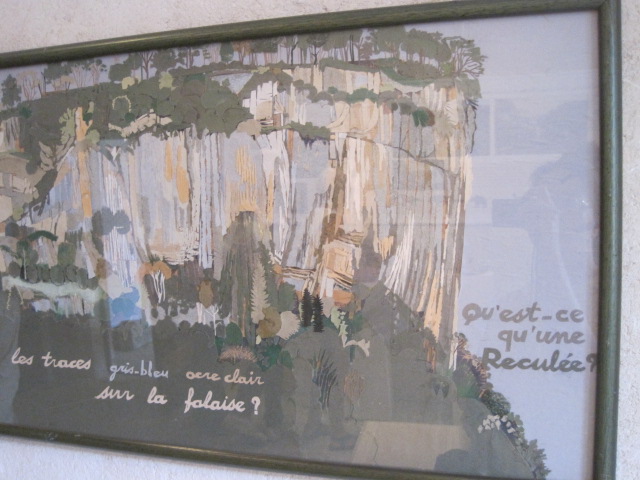
Josette Coras (1926-2008) was an engraver and artist who lived in the ancient Abbey of Baume les Messieurs in the Jura most of her life. The Abbey lost its religious status during the French Revolution, and is still lived in by different residents and families. Her art works are interesting, for their technique rather than for their content. She did watercolours, engravings, and paper sculptures. I visited the summer exhibition devoted to her in the Abbey of Baume yesterday. What struck me was the images she produced towards the end of her life which had some scientific and didactic content, about the area she lived in : the steephead or blind valley of Baume. She produced a work representing the rock face of the valley, drawing attention to hydrological and geological features, with a set of questions, such as "What is a blind valley?", "Why are there bluish-grey or brown streaks on the cliffs?", "why do stones fall from the cliffs?" - You see below the two extremities of this work of art.What is remarkable is that, though it is not visible here, the entire work is not painting or watercolour, but bits of torn paper, even the trees on the cliff tops...Quite beautiful!

Josette Coras (1926-2008) est une artiste spécialisée en gravures qui vécut la majeure partie de sa vie dans l'Abbaye de Baume les Messieurs dans le Jura. L'Abbaye a été vendue comme bien national à la Révolution, elle n'a plus de fonction religieuse et est toujours habitée par différents propriétaires et familles. Les oeuvres de Josette Coras sont intéressantes, surtout en raison de sa technique, plus que de leur contenu. Elle utilisait la gravure, l'aquarelle et a fait des sculptures en papier découpé. J'ai visité hier l'exposition qui lui est consacrée cet été sur les lieux mêmes où elle a vécu à Baume. Ce qui m'a le plus intéressée, ce sont
les oeuvres scientifiques et pédagogiques qu'elle a produites à la fin de sa vie, sur la reculée de Baume. Il y avait notamment une longue représentation des falaises de la reculée, attirant l'attention sur certains aspects hydrologiques et géologiques, accompagnée de questions comme : "qu'est-ce qu'une reculée?", "Pourquoi certains rochers se détachent-ils de la falaise?"; "Pourquoi y a-t-il des traces gris-bleu, ocre clair sur la falaise?". J'ai pris en photo les deux extrémités de cette longue oeuvre. Mais ce qui est remarquable, et invisible ici, c'est que l'oeuvre entière n'est ni de la peinture, ni de l'aquarelle, mais entièrement faite de morceaux de papier déchiré, même les arbres apparaissant au sommet des falaise...C'est très beau!